In the last 30 years the Tech industries have caused a significant drop in the demand for unskilled labor, weakened the power of centralized governments and decreased labor’s regulations. And they did that so quickly and so broadly, that one could rightfully argue Tech is alarmingly reverting our societies to a modern version of the feudal system.
A “traditional” feudal society resembled something very much similar to this: There was a king, who owned the whole kingdom; there was the noble class, who received lands from the King in exchange for loyalty, money and soldiers; there were the knights, who received land from the nobles in exchange of military services. And finally there were the peasants, who basically received the right to work a piece of land (and sometimes not even that) in exchange for services and (almost) everything they produced.
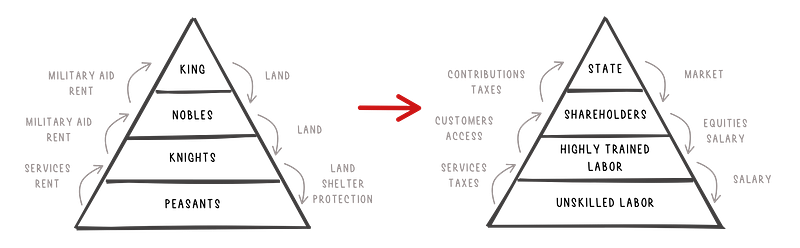
Today of course we don’t have Kings, Nobles, Knights and Peasants. Instead, we have an increasingly powerless government, a rising group of shareholders, a class of expensively trained workers and a growing set of unskilled laborers. But the essence is starting to be the same.
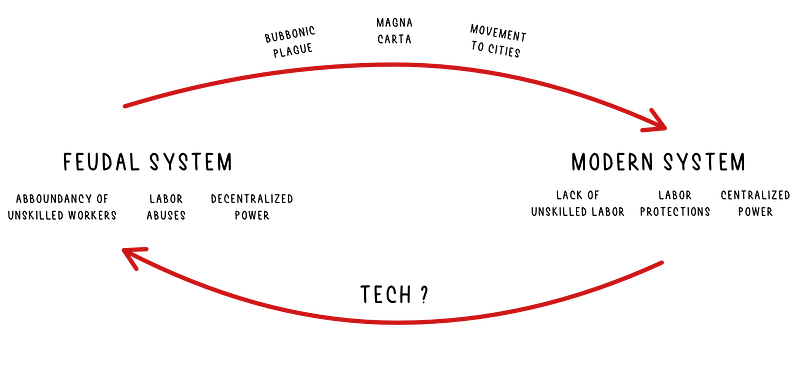
To better understand this analogy, we should take a look at what killed the traditional feudal societies in the first place, and then verify if such processes are effectively being reversed.
How did we evolve from a feudal society
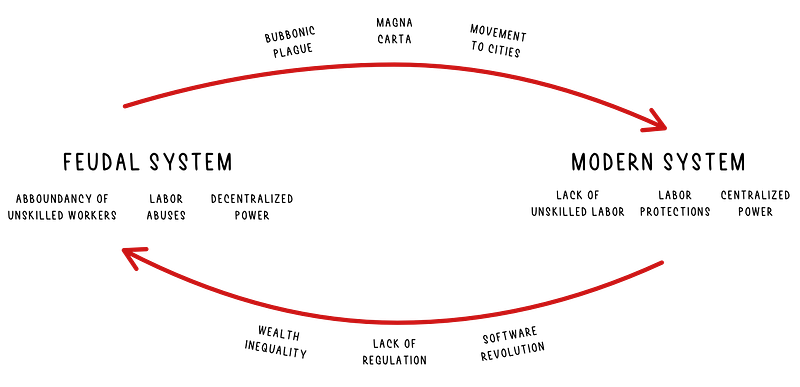
When it comes to the Middle Ages, scholars generally agree that 3 things contributed the most to their end. First and foremost, the sudden scarcity of labor the whole european continent experienced due to the bubonic plague.
For a long time ‘peasants’ had indeed no ability to raise their voices over the upper classes as labor was cheap and widely available. As the Bubonic plague killed an incredible amount of people in a very short time, those who survived found themselves with enough economical power to demand more money and more rights in exchange for their services.
In addition to that, many people abandoned the countryside and moved to towns and cities looking for a better life which considerably weakened the power of nobles over the king. Until that time indeed, the king had very little ability to control its kingdom since all military resources were controlled directly by the nobles and “made available” only under the right circumstances.
As more and more people began moving to cities however, the nobles’ ability to provide military aid significantly decreased and the king power rose. This was a crucial turning point in western society since it paved the way to the centralization of power into a single entity which will eventually give birth to the modern concept of State.
However, none of those factors would have meant anything if it hadn’t been for the rise of a new juridical system that set shared rules, increased protections of the lower classes and limited the power even kings could exercise over their subjects (Magna Carta).
These three conditions alone made the feudal system an obsolete form of society and opened the way to the rise of the middle class, the french revolution and the birth of democracy. And these three same conditions are today rapidly disappearing under the (unconscious) doing of the T_ech industry._
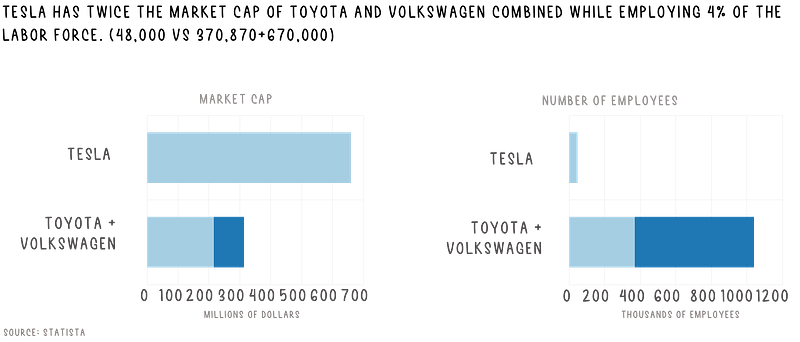
The essence of Tech is to disrupt entire industries by leveraging the costless scalability of software.
Since the marginal cost of adding one user to the network decreases as the network becomes bigger (it can even go to 0), tech companies have been able to satisfy entire markets at marginally decreasing costs.
You don’t need more than one Google, one Amazon, one Airbnb or one Uber to satisfy market needs. One company can easily take care of the whole market demand. Actually, one company can more cheaply take care of the whole market demand since competition would increase marginal costs and decrease production quality.
Something that is directly correlated with the way software works and can be summarized with the following example. The more people are on facebook, the more value each user can extract from the network. Because of that, competition in the social networking space would likely decrease the overall value for customers as it would reduce the size of each network. And at the same time, it would also increase overall costs for both companies since marginal costs tend to be 0 after a certain threshold. A lose-lose.
Using a different example, not only Amazon can alone satisfy all the demand when it comes to a digital marketplace, but it is able to do exactly because of its scale. As the number of clients and orders of Amazon increases, the cost for shipping (or returning) each order decreases and this allows Amazon to operate for profit and provide customers with the best service. However, if Amazon were to lose 50% of its market, it would quickly lose all of its market since its operational cost would skyrocket.
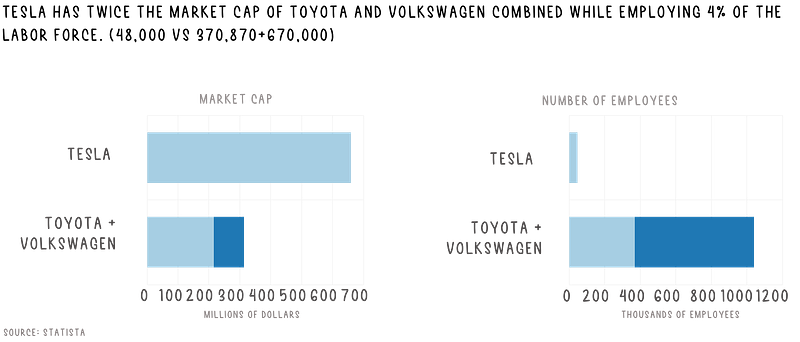
An uncomfortable consequence of such incredible dynamics is that the labor necessary to satisfy a whole industry sector has suddenly shrunk to a single company (and a fairly small one) which means that a lot of people are losing their jobs.
This is something that has, of course, been happening since the industrial revolution but the peculiarity of the last 30 years is the speed and broadness at which such a process has been moving.

Technology improvements have been shifting labor demands since the dawn of time. A plow with a pair of bulls can do in one hour what many farmers would do in a day so I am pretty sure quite some farmers “lost” their job to a plow back in the days.The real difference is that, until today, technological advancement has generally moved slow enough to give most of society the time to adapt.
Farmers eventually stopped working the land and started manufacturing plows, building storage facilities et cetera et cetera. In the rare occasions in which innovation disrupted an industry, (most of the times) people had the time to learn new skills and find new ways to generate value for society.
But today things are moving so fast so broadly that people are seeing multiple disruptions happening in just a few years and simply don’t know how to catch up.
The travel industry, the hospitality industry, the cab industry, the news industry, the music industry, the movie industry, the retail industry, they all became obsolete in basically 10–15 years. In less than two decades, millions of workers suddenly found themselves without a place to work, with a skillset that became useless overnight and with very few opportunities left available to them.
You can’t tell a 45 year old travel agent to become a surgeon or learn how to code. He just won’t be able to make it. And at the same time you can’t even tell him to go work in retail or hospitality or become a taxi driver since those industries are being disrupted too.
Putted in more bluntly, as tech is disrupting so many industries that were once at the foundation of the lower and upper middle class, the middle class itself is collapsing into unskilled labor. This is thus making unskilled labor way more available than what the market demands and, as a direct consequence, is erasing the leverage workers had over the upper classes.
Just like before the bubonic plagues, workers have indeed now very little ability to negotiate with their employers which is allowing companies to hire at cost. And as laborers are earning just as much as they need to survive, it is today also impossible for the lower class to profit off their work and thus change their social status.
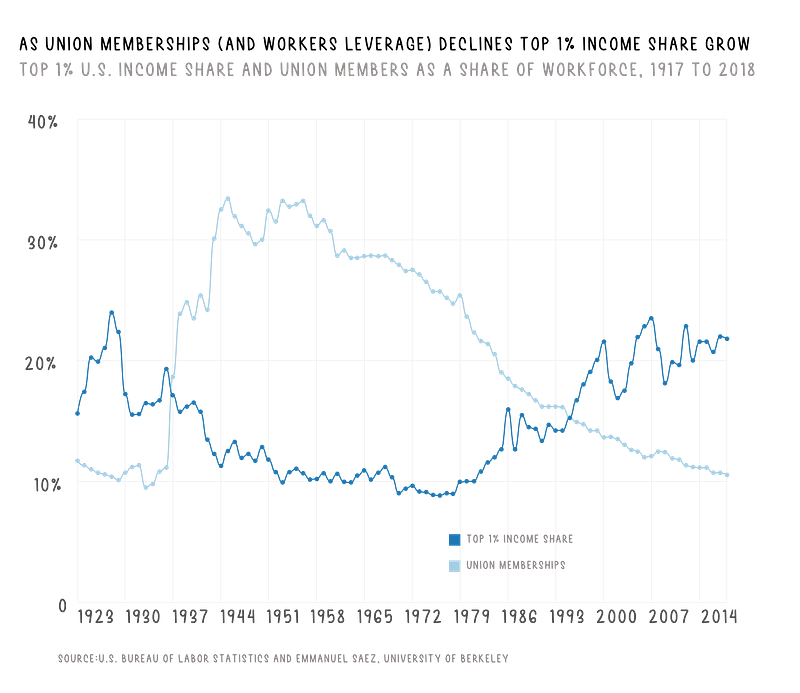
This is the same vicious cycle that trapped peasants at the bottom of the social pyramid during the middle ages. With no access to the means of production (expensive education) and no chances to generate profit, people have no chances to improve their social status and end up living simply to produce.
One might wonder, where is the government, where is the state, where is the welfare, where is that centralized entity that should (and could) take care of this problem, where is it ? Nowhere. Simply nowhere. Disappeared.
Because the issue is that even the Government is being disrupted by tech. Just like the nobles lost control in favor of the king in the 17th century, the government is now losing such control back to the shareholders (the new nobles).
Yes, technically our political structure is the same as “always” and it is very much different from a feudal society. People vote and elect their representatives, those representatives create a government and such government rules the country for a limited period of time with the only goal of pursuing the common good. Different from having nobles and kings, I agree.
However, in particle terms things are much more similar to a feudal system that one might think. Politicians (or a political party) effectively work just like companies: they look for votes (customers) so that they can be elected (generate profit). And how do you get votes? Just like you get customers. You buy them. And where do you get the money? From contributions.
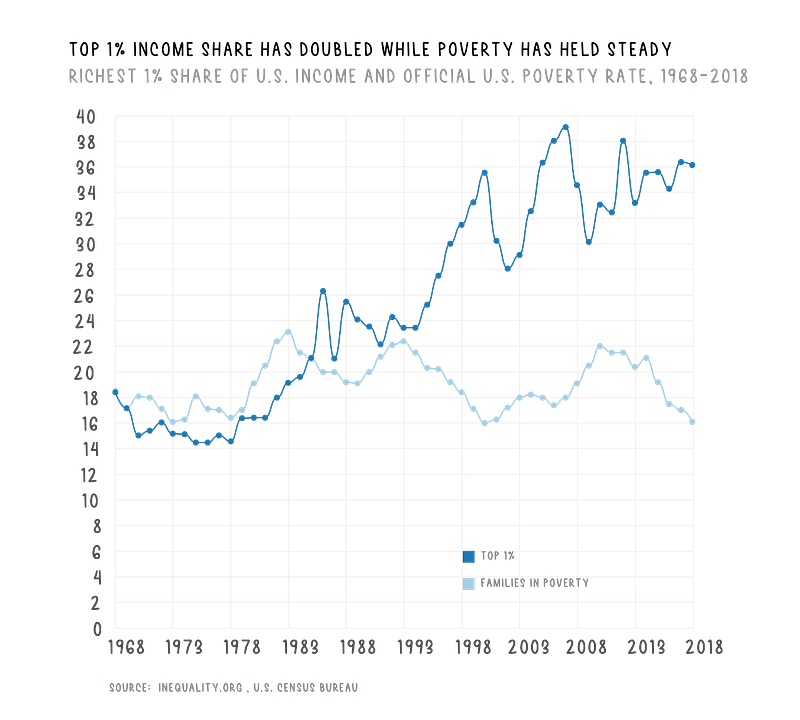
I know, I know, it is a little bit more complicated than that…but also it is not. Except for very specific and unique occurrences, most governments are elected, survive and rule just as long as they are able to protect the interests of those who pay the most, not of those who are the most.
It just happened to be that, historically, these two classes of people often coincided (or were at least very close). Since the middle class represented a significant percentage of the population and it held a significant percentage of the economical interests, protecting the middle class meant protecting both the most of the population and the most payers.
However, as we discussed above, the economic power of the middle class is now migrating into the hands of few highly skilled workers and shareholders (modern days knights and lords) and an extremely small percentage of the population is acquiring an extremely high percentage of economical interests.
And since politics is a financial game, the ridiculous amount of capital available to those people allowed them to make sure their interests were being protected over the common good. Which led to the paradoxical scenario where few people’s interests represented the overall country’s interests.

No matter what everyone says, we indeed live in a plutocracy (society that is ruled by people of great wealth) with a cheap coat of democratical paint, nothing more.
And because of that, the government (which is formally elected by the majority of the population) has now lost all its power over to the shareholders (which effectively detain the access to the means of productions).
And it is not by chance that indeed trust in the public institutions is today at an historical minimum. With the erosion of the middle class and the rise of companies managed with such a ridiculous profit over employee ratio, the state lost any ability (or interest) to rule over the majority of its subjects.
Ironically enough, such transition of power has been even matched by the first urban exodus in the last 400 years, which represents the exact opposite phenomenon that happened at the end of the feudal system.
As technology freed us from the need of working in a city, people are now returning to the countryside for a better life. This will undermine even more the ability of a centralized Government to provide for its subjects (and thus justify its power) since operational costs will skyrocket once people will disperse.
Sanitation, Health Care, Education, Transportation. All these services are sustainable in a centralized way only when a certain critical mass is achieved. But in a world where people are living in smaller communities, such essential services will have to be handled back to smaller entities that will likely have the form of half-public half-private organizations.
In other words, just like peasants had to rely on their local noble and not on the king to ensure justice, safety et cetera et cetera, we will soon return to a society where decentralized and locally private entities will be asked to take care of our needs.
None of these would have been possible, however, if it hadn’t been for the incredible lack of regulations that the tech industry experienced in the last 20 years.
Similarly to what nobles used to do before the Magna Carta, in the last 15 years tech companies have been able to walk over multiple rights of the middle class and gain way more power over the labor class that the state should have ever allowed.
The middle class has obviously been trying to stop such a process but, once again, the rise of the tech industry has been way faster than what the regulators have been able to control. This is why today you are seeing such a strong political debate over imposing stricter rules to the tech industry, especially in the EU. Because the middle class is trying with its last resources to stop this “madness” and the EU represents a more responsive society to anti-capitalistic policies.
It should now be easier to see how the three major components that set the death of feudal societies, the scarcity of labor, the centralization of power and the rise of a juridical system protecting the masses, have been significantly eroded in the last 20 years and a major merit goes to the tech industry.
So, are we actually living in a feudal world? Well, almost but not completely.
One fundamental difference still stands between a feudal society and the world we live in.While kings or nobles didn’t do anything to maintain or justify their position in society, giant corporations rise and stay in power because they generate “value” for their customers.
Such apparently simple details is actually the direct by-product of the extremely complex system supporting a free market capitalist society. Something we have and feudal societies didn’t have.
In very few words, in a free market high margins businesses attract competitions and force market leaders to constantly fight over the ownership of the best means of production to maintain market share. There is no King saying that if a better search engine appears, that shall be handed to Google. Because of that, Google must continue to provide the best possible search engine or it would lose its customers.
This represents a structural difference between the feudal society and our world since it defines how ownership of the means of production (and thus wealth) can change, which in practical terms makes social mobility possible, GDP growth incentivized et cetera et cetera (to be fair it is actually much more complex than this, but you get the gist).
However, as free markets aren’t naturally baked into capitalism or democracy (they aren’t naturally baked into anything actually) they need to be maintained by 3rd parties or they die pretty quickly.
Generally speaking, the western world has always been quite in favor of free markets and has always made the effort to identify and break any monopoly. Nevertheless, in the last decades something has changed in the minds of the regulators.
As governments have been generally responsible to identify and break monopolies, the economic incentives to maintain a free market must be bigger than the incentives backing the monopoly itself. This has generally been the case since free markets tend to stimulate competition, innovation and thus economical growth while monopolies generally lead to growth stagnation and production perishment.
Nevertheless, as we mentioned above, in the last 20 years we witnessed multiple counter examples to such belief as single tech companies seems to have proved how establishing monopolies was not only possible but also necessary to minimize market inefficiencies.
Such unthinkable dynamics made the regulator wonder if protecting tech monopolies was actually a better idea than breaking them. However, as tech companies have begun expanding outside of the information industry, a fundamental question started to arise. What should the regulator do about it?
It seems indeed clear that an increasing number of industries is being swallowed up by tech companies. Indeed, as software is becoming the gateway to any industry sectors, the companies that control such a gateway effectively control the underlying industry.
Right now Apple alone has its hands in the healthcare industry, the communication industry (software AND hardware), the payment industry, the music industry, the movie industry, the gaming industry, the retail industry and so on…
Just like the nobles controlled the access to the two main important resources of the middle ages (land and labor), tech companies are now starting to control the access to the two most important resources of modern times (markets and customers).

It goes by itself that even the last standing difference between our society and a feudal system is slowly disappearing.
As we indeed begin to look at Google, Amazon, Twitter, Facebook or the Gates foundations to stop global warming, control pandemics, avoid misinformation or produce vaccines, what are we saying about our own governments?
What’s the actual difference between a world where the common good is left to the benevolence of few private entities and a society where nobles and lords decide whether a simple man will starve or survive during the next winter? Or how is a government incapable of putting the common good above the interests of a few companies better than a powerless Kings at the mercy of nobles?
And is the status of an Uber driver significantly different from the life of a farmer of the 17th century? Don’t they both have no leverage over their employer? Don’t they both earn just as much as they need to survive? Don’t they both have no possibility to increase their wealth or change their social status? Don’t they both live in the same society?
This article is an “un-educated reflection” that needs to be taken cum grano salis