Why don’t we have celebrity doctors but we do have celebrity actors? Why do few rockstars make so much more than the rest of musicians? In other words, what are the characteristics of “superstars market” markets (AKA winner-takes-it-all)?
The power of Scale
To begin answering this question we should go back to the first rigorous study of a “superstars market” made by a famous english economist named Alfred Marshall towards the end of the 19th century.
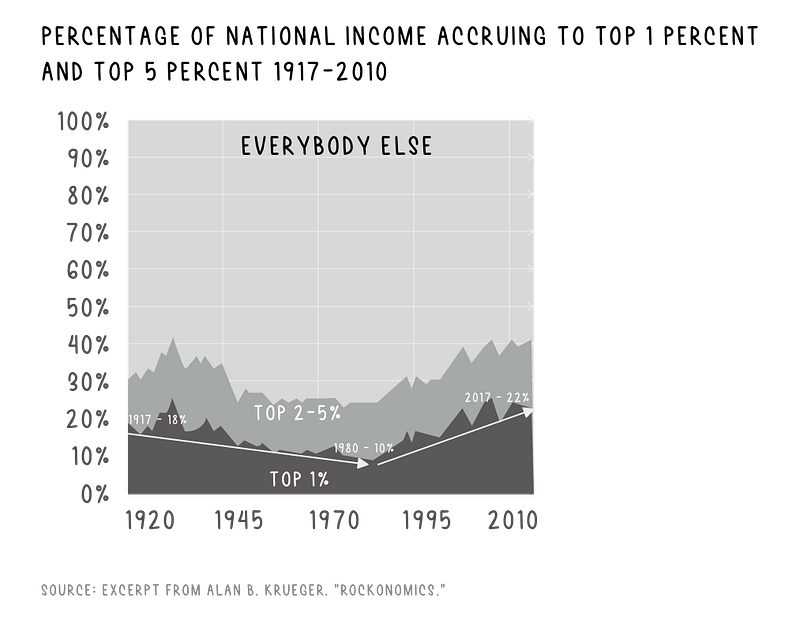
Marshall wanted to understand why in the second half of the 19th century a small number of businessmen were suddenly able to earn greater and greater salaries, while the rest of the english workforce were not seeing any significant growth in their compensation.
After careful considerations, Marshall concluded that the growing income gap between these “business superstars” and the rest of the population, was mainly due to a new piece of technology in the communication field called Telegraph.
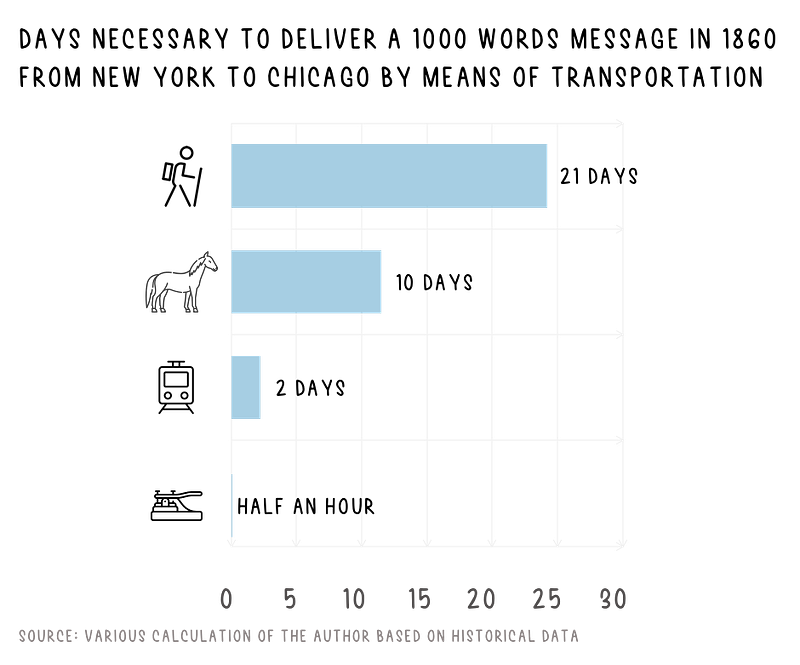
Discovered towards the beginning of the 19th century, but spread during the second half, the telegraph was enabling businesspeople to command alone far-flung empires, and reap the rewards of operating on such enormous scale. From Great Britain to America, from India to Australia, top entrepreneurs were suddenly able to apply their skills and abilities to a much wider market than they used to be, and thus significantly increase their returns (and salaries).
The key aspect allowing these “business superstars” to earn supersized incomes, however, was not simply the increased size of their market but also how such increase had been achieved: almost without cost.
To better understand this phenomenon think about what happened to the music industry when the gramophone was invented. While performing a song in a theater or in a music studio costs almost the same to an artist, the markets that such single performance addresses are significantly different; one is limited by the people fitting into a theater, the other one by the people able to buy a recording.

In the same way, since the 1830s, the telegraph gave top businessmen a way to apply their knowledge (communicate with factories, suppliers, vendors, distributors et cetera et cetera) to a much wider market with almost no additional effort.
In other words, both the telegraph and the gramophone allowed businessmen and singers to perform their jobs at a bigger scale without significantly increasing their cost, which eventually increased their returns exponentially.
Nevertheless, is operating at scale enough to create a superstar market? No, it’s not. (At least most of the time — see note at end of article).
The uniqueness of imperfect substitute goods
Let’s take, for example, the paper industry. It is reasonable to believe that today a single company could satisfy the whole market demand (with multiple factories of course). However, we know for a fact that there is no paper supplier holding a market share disproportionally bigger than its competitors. In other words, there is no “superstar” in the paper industry (aside from Dunder Mifflin). Why is that?
Because even if scale is a necessary ingredient to create a superstar market, it is not a sufficient one.
Contenders of a superstar economy, indeed, not only need to be able to address the majority of the market with little incremental costs, but they also need to be “imperfect substitutes”.
An imperfect substitute good is something so unique in style or skills that can’t be fully substituted by another product in the market.
When you look at the paper industry you can easily see how each company produces a product almost equivalent to the others. Certainly paper comes in different quality, material, price, size et cetera et cetera…but overall it’s all pretty similar to the eyes of consumers. No piece of paper is so special that it can’t be substituted or copied by another company. Therefore, no company is able to capture the majority of the consumers’ demand.
In other words, since there are alternatives available to consumers when it comes to paper, the demand for a specific paper brand is forced to remain equivalent to the demand of any of its competitors. Which basically prevents a specific product from achieving market dominance and thus “becoming” a superstar.
That is why, even if paper companies can operate at a huge scale, they don’t give birth to a superstar market. Because their products are not an imperfect substitute good.
On the other hand, if we go back to our previous example (the music industry) we find a significantly different situation.
You can’t take Bruce Springsteen & The E Street Band and replace them with a cover band that plays their same music. And this isn’t simply because their performance abilities might be different (there are indeed cover bands just as good as the original one), it’s because people know and feel that they are not the same thing.
No matter how good a cover band is, it will never be able to replicate the original artist’s performance as a whole. The cultural value, the audience awareness of sharing the same experience, the uniqueness of the performers outside of the stage et cetera et cetera…all of this can’t be substituted.
Said it in a cheesy way, you can replicate the sound of music but you can’t replicate its soul (or brand).
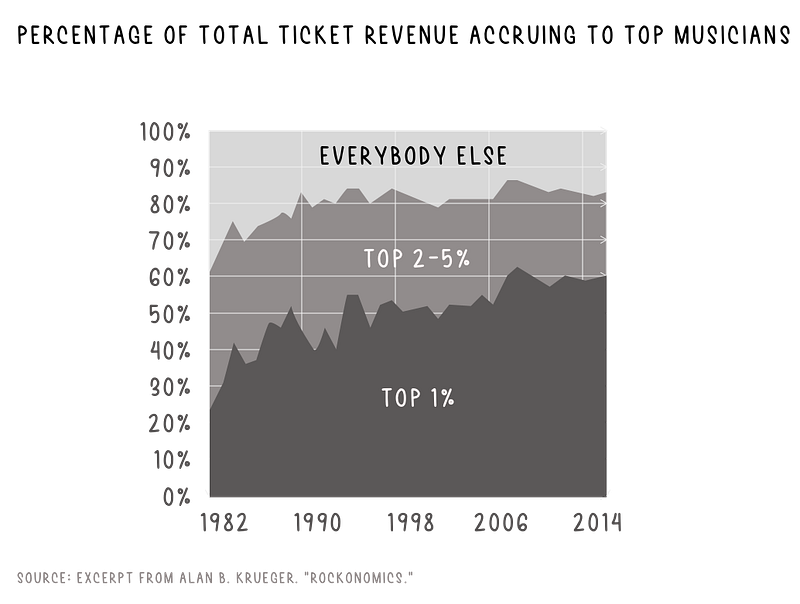
Music is, therefore, a superstars market since musicians are an imperfect substitute good that can operate at huge scale with very limited marginal costs (as previously discussed). And that is why Bruce Springsteen & The E Street Band are paid $2.8M per night and any of their cover bands are lucky to make 0.1% of that. After all, why would anyone pay for a cover band when you can listen to the “real thing” on Spotify (and for much less)?
Anyone can be a superstar
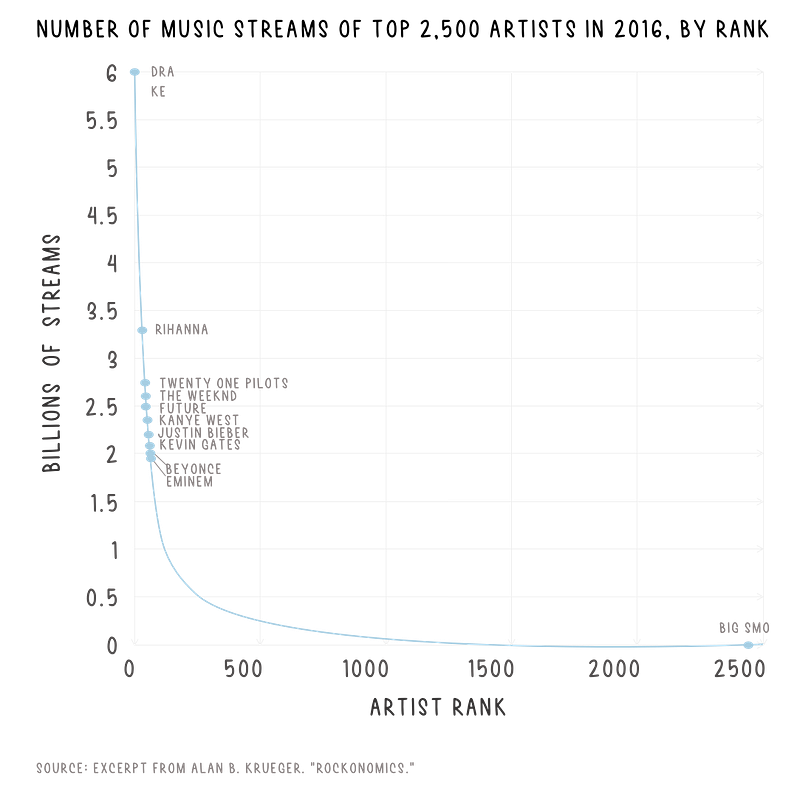
It’s worth noticing that similarly to how operating at scale isn’t enough to have a superstar market, having an imperfect substitute good alone isn’t either. It’s the combination of these two characteristics that create the “magic”.
One of the earlier questions of this post is indeed “why don’t we have celebrity doctors”. Well, that’s exactly why. Because while the medical field can be an “imperfect substitutes” market (some doctors are able to perform specific treatments that others can’t perform), doctors lack the necessary scale to generate a superstar ecosystem.
No matter how efficient a doctor is, they simply can’t capture the majority of the market since the number of patients they can treat concurrently is ridiculously lower than the overall number of patients existing at any given time. Because of that, the income range of doctors is much more narrow and equally distributed than the one of musicians.
Nevertheless, this doesn’t mean that doctors will never be superstars but simply that currently they lack a key characteristic to become one.
It is indeed very important to understand that markets aren’t born Superstar, they are made such.
It was the gramophone that gave musicians a way to perform their work at great scale and gave to music the missing ingredients to turn into a superstar market. And until that moment, musicians weren’t any more superstars than what painters are today.
In the same exact way, the medical field (or any other one) could turn into a superstar market through the right technological and cultural development.
Some actually say that 5G will allow doctors to treat patients all over the world thanks to remote controls and automated robots, which will significantly increase doctor’s ability to operate at scale and treat more patients concurrently.
Conclusion
It should now be easier to understand what are the characteristics of the so-called superstars markets and why some people manage to make so much more than their colleagues.
Thanks to scale and imperfect substitutes goods, superstars are indeed able to capture the majority of a market demand while keeping costs constant, which eventually lead significant profits.
An outstanding question nevertheless remains: Is our economic system prone to eventually transform any market into a superstars one? Which is another way to say, is wage inequality a growing trend across all industries?
That is however a much more complex issue that is strictly connected to how information behaves and deserves a dedicated deep dive.
Note
Some companies make scale itself their “unique factor” but that’s possible only within natural monopolies or “high barriers to entry” markets, which are very different from superstar markets.
A superstars market is a market with many players but few winners, like the music industry or the C-level executive industry. There are indeed many rock bands or managers in the world, but the majority of the market (revenue wise) is addressed by very few of them. You can’t say the same about the airline’s industry since there are very few airlines in the first place.
Because of that, even if most of the market is satisfied by few companies when it comes to flying, we tend to call the airlines industry an oligopoly rather than a superstars market.
This article is an “un-educated reflection” that needs to be taken “cum grano salis”
Reference to: