For 100 years, the market power of the entertainment industry has remained concentrated in the hands of the same five to six labels, also known as “majors”. From cinema to television, from radio to CDs, from cable to VHS, to DVDs to many more…no matter what disruption has hit the market, for one entire century the same few companies managed to stay miles ahead of the competition and maintain dominance of the entertainment business.
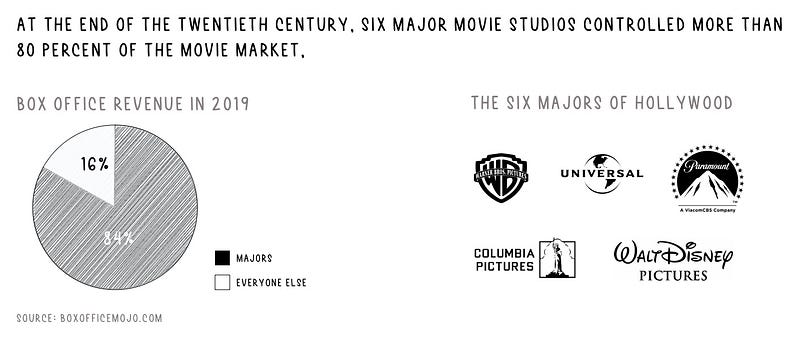
Today and for the first time since the birth of Hollywood (1910s), the market dominance of the majors is slowly disappearing in favor of a new “beast” of the media world: tech companies.
In this 3 article series I will therefore try to answer to the the following questions regarding the entertainment industry:
- How (the hell) did the Majors maintain market dominance for one entire century.
- How (the hell) did the Majors miss the digital revolution and why it was like nothing previously seen.
- How today’s entertainment is radically different from what we have been used to for both a a content and business perspective.
How (the hell) did the M_ajors_ maintain market dominance for one entire century.
Said it briefly, the key to the majors’ dominance over the entertainment industry has been their ability to use economies of scale to manage the cost and risk of bringing new content to market and retain tight control over both the upstream and downstream ends of the supply chain.
This sentence is quite dense and it’s worth unpacking it one part at the time to make it more digestible. Let’s start with “Risk management”.
For the most part of the 20th century there has been very little data about the entertainment industry and estimating how much a creative project would generate was extremely difficult (if not impossible).
Record companies, for example, could only make the most unscientific of predictions when trying to understand how well a new artist or a new album would do in the market. They would put together focus groups, or study attendance figures at early concerts, but these were exceedingly rough measures based on tiny samples that were of questionable value when applied to the broader population.
In other words, there was no method to estimate which projects would succeed once green-lighted and companies had to rely on their A&R (artist & repertoire) departments, which were made up of people optimistically hired for their superior instincts (also known as media moguls).
It goes without saying that most of the projects never made profits and the entertainment business was more of a game of chances than a game of skills
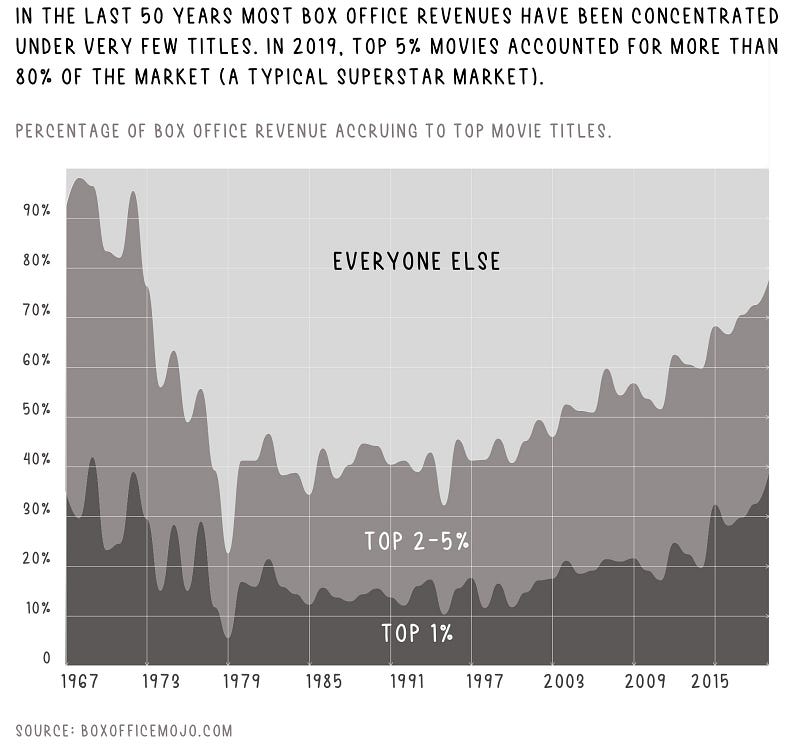
Nevertheless, one successful project could pay back many failures as the media industry presented (and still does) a very vertical distribution of market winners (a.k.a. a superstars market).
Therefore, thanks to their deep pockets, the majors were able to invest in multiple projects at the same time and thus limit their exposure to failure.
In this respect, the majors operated very much like venture capitalists since they allocated significant volumes of capital across a long tail set of investments each of one of them with big returns multipliers. Something that instead smaller labels weren’t able to do and thus often ended up going out of business.
Risk Management, however, isn’t the only advantage that scale gave to the majors as it also allowed them to tightly control both downstream and upstream of the creative supply chain.
Identifying and green-lighting potentially successful projects was indeed only the beginning of the job for the majors. Just as important were the downstream tasks of promotion and distribution of the content.
In the music industry, for example, once a company had invested in signing an album or developing artist as a star, it had to invest seriously in getting the artist’s songs heard on the radio, making the artist’s albums available in stores, and getting the artists booked as a warm-up act at big-name concerts.

Consider the challenges of promoting a new song on radio. It is estimated that in 1990s the major record labels were releasing approximately 135 singles and 96 albums per week. However, radio stations were adding only a handful of new songs to their playlists per week. In other words, the marketplace was quite crowded.
Companies therefore had to resort to all sorts of tactics to get their songs on the air. This often meant giving radio stations access to the major labels’ established stars (through concert tickets, backstage passes, and on-air interviews) in exchange for playing songs from labels’ new artists.
The Majors also practiced the so called payola, the illegal practice of paying under the table DJs and stations that played certain songs. Getting a song on the radio more often than not wasn’t about local fans base or music quality, it was about the resources that a label was able to deploy to get the piece pushed through.
Nevertheless, promotion was useless without distribution and for labels to make money, consumers had to be able to find and buy their music once they decided to.
In the pre-Internet, pre-digital era, this meant having your content available in music store and more in general retail stores. One peculiarity of those stores compared to their today digital equivalent, is that shelf space was very limited back in those days.
Most local record stores carried small inventories, perhaps no more than 3,000 or 5,000 albums. Even the largest of the superstores of the 1990s — glorious multistory spaces with whole soundproof rooms devoted to various genres — stocked only 5,000 to 15,000 albums.
Because of that, labels had to compete to even get their content on the shelfs (not to mention to get it on the best shelfs). And just like with the radio, the majors therefore tent to promise benefits in exchange for space.
To convince store managers to take a risk “on devoting scarce shelf space to new music, the labels leveraged their stable of star artists, by offering access to in-store interviews, advance copies of albums, free merchandise, and more.
In other words, record companies had to do everything they could to make people notice their artists and their decisions were gambles with big risks — which meant that the “little guys” couldn’t compete.
The movie industry presented a very similar situation. As the number of movie theaters was limited, so was the number of movies that could be screened every single day. Studios had to fight each other to get their movie out and promotion budgets were one of the most effective weapons.
Theater owner wanted to be sure that whatever movie they were going to screen, it was going to sell tickets. And what better reassurance than knowing the amount of money studios were going to spend in marketing and advertising?
Not to mention the fact that, oftentimes, studios were selling their movies as a bundle to theaters chains. As screen owners were interested in securing access to blockbuster movies (since those were safe money makers), studios were bundling those deals with less desirable/known movies so that they could launch a new artist or recover other returns.
These were, of course, impracticable techniques for smaller studios as they had no way to compete with the majors’ promotion budgets nor movie catalog.
On top of that and thanks to this downstream control over the entertainment supply chain, the majors also managed to have upstream control.
Thanks to their deep pockets and willingness to go above and beyond when promoting their artists, big studios were able to regularly poach rising stars from smaller labels and suffocate any possible competing effort.
In the rare cases independent companies managed to successfully launch new artists and gather market momentum, the majors would indeed step in and lure the talent with fat contracts that were impossible to compete with (that’s why artists were often accused of selling out). An approach that made even more difficult for smaller labels to retain artists and therefore capitalize on the few good bets they were able to win.

It should now be easier to understand how scale played a critical role in defining market dominance of the entertainment industry.
On one hand, the big studios were able to reduce their risk of failure by spreading their investment across many different projects and therefore significantly increase their chances of positive returns.
On the other hand, they were able to control both downstream and upstream ends of the creative supply chain by deploying big promotion budgets, bundling sales operations and offering impossible to refuse contracts to the best stars, which consequently ensured them (exclusive) access to both the best revenue generating streams (prime location stores, biggest theaters…) and best production material (top of the class artists).
And because these market characteristics persisted throughout the whole century, it is natural to conclude that no change in market power could have happened in the entertainment industries.
Nevertheless and as previously mentioned, for the first time since the birth of Hollywood (1910s), today the market dominance of the Majors is shaking in front of a new “beast” of the media world: tech companies.
From Music to Movies (and publishing), how did the Major lose their tight control over the industry? What fundamental changes did tech bring that big labels weren’t able to dominate? And what does that mean from both a business and content perspective?
All content for the next chapters.
This article is an “un-educated reflection” that needs to be taken “cum grano salis”.
Reference to: